Trading Journal vs Pre-Trade Grading: Why Recording After Isn't Enough
A trading journal records what already happened. Pre-trade grading scores the setup before you click buy. Here is why a predictive journal beats a reactive one, and how to run both.
Open any trading journal and look at when the entries get written. After the trade. Entry, exit, size, a note about how it felt. All of it logged once the money is already gone or made. That is useful for the next 50 trades. It does nothing for the one you just took. A journal is a rear-view mirror. Pre-trade grading is the windshield. This post is about trading journal vs pre-trade grading: why you want both pointed at the road, and why the windshield is the one most traders are missing. If you already keep a journal, you are halfway there. Most traders only run the back half.
Quick Answer
A trading journal is reactive and pre-trade grading is predictive. The journal records what already happened, entry, exit, size, and how it felt, which only helps after the money moved. Pre-trade grading scores the setup before you click buy, so the feedback arrives while you can still act on it. The two are complements, not alternatives: grade the chart to decide whether to take the trade, then journal it so you can see your own patterns over months.
The Problem With Recording After the Fact
A trading journal is a recording device. You fill it in after the trade closes, which means every lesson it produces arrives at least one trade too late. You learn that you keep chasing extended moves only after you have chased another one. You learn that your 11 AM trades lose money only after you have taken another loser at 11:15. The journal is honest. It is also slow, because feedback that arrives after the decision cannot change the decision.
There is nothing wrong with that on its own. Most learning works this way. The issue is that traders treat the journal as their whole feedback system, then wonder why they keep making the same entry mistake for the third week running. The journal flagged the mistake every time. It just flagged it after the click, which is the one moment it could not help.
The trades that actually hurt are the impulse entries: the C-grade setup you took because the stock was moving and you did not want to miss it. By the time you write that one up in the evening, calm and clear-headed, you already know it was a bad take. The version of you that needed to know was the one at 9:47 AM with a finger over the buy button. That version never saw the journal. We dug into why that gap exists in the post on building trading discipline as a system rather than a willpower contest.
Reactive Journal vs Predictive Grade
The cleanest way to see the difference is to line the two up against the same questions. A journal and a pre-trade grade are not competitors. They sit at opposite ends of the trade. One looks back, one looks forward.
| Question | Reactive journal (after) | Predictive grade (before) |
|---|---|---|
| When does it run? | After the trade closes, often hours later | At the decision point, before you click buy |
| Can it change this trade? | No, the money is already committed | Yes, you can still skip the setup |
| What it answers | What patterns show up across many trades | Is this specific setup worth the risk right now |
| Main failure mode | You skip it after a draining session | You override the grade and take a C anyway |
| Emotional state when used | Calm, in review, outcome already known | Live, excited or scared, outcome unknown |
| Best at | Long-term pattern spotting and strategy review | Filtering out the impulse trade in real time |
Read down the "Can it change this trade?" row. That is the whole argument. A journal is information about trades that are already over. A grade is information about a trade you can still walk away from. Both are valuable. Only one of them can save you money on the next click.
What a Journal Is Actually Great At
None of this is a case against journaling. A journal does things a single grade never can, and if you are not keeping one yet, you should be. Over a large enough sample it surfaces the truths your memory hides from you.
Pattern across trades
One trade is noise. Fifty trades with notes attached show you that your bull-flag trades win and your reversal trades bleed, or that you tilt after a red open. That signal only exists at the level of the sample, and only a journal holds the sample.
Behavior you can't see live
Position sizing creep, taking trades outside your watchlist, holding losers past the stop. These are habits, not single events. The journal is the only place they show up as a trend instead of a one-off you can rationalize away.
Strategy iteration
Tightening your rules requires data on what your current rules actually produce. The journal is the dataset. Without it you are tuning a strategy on vibes and the last trade you remember, which is almost always your most recent loss.
So keep the journal. The argument is not journal versus grade. It is that the journal is the back half of a loop, and most traders are running it with the front half missing. The detail of what to actually record (and what is noise) gets its own treatment in the guide on which trading journal metrics matter and which to drop.
The Missing Front Half of the Loop
Picture the full feedback loop of a single trade. You spot a setup, you decide, you enter, you manage, you exit, you review. A post-trade journal covers the exit and review. It records what came out the back end. Everything that happened at the decision point, the part where the trade was still optional, goes unrecorded except as a note you write from memory hours later.
That note is unreliable on purpose. Once you know the outcome, you cannot un-know it. A losing trade gets written up as "I forced it," a winning trade with the identical setup gets written up as "I trusted my read," even when the chart looked the same at entry. Outcome bias rewrites the decision in your memory to match the result. The research on this is old and consistent; the behavioral-finance literature on hindsight bias shows people consistently misremember what they believed before an outcome was known.
A pre-trade grade fixes this by recording the setup before the outcome exists. It is a journal entry created at the only moment the decision is still live and your read is still uncontaminated. The grade is a fixed score, printed, timestamped before you knew whether the trade won. When you review later, you are comparing a real prediction to a real result, not a memory of a prediction reconstructed to fit the result.
That is the front half of the loop. It is not a replacement for the journal. It is the entry the journal cannot write, because the journal does not exist yet at the moment it would matter. Your next setup is the first one you can record on the right side of the trade.
Record the Setup, Not the Regret
Grade the chart the moment before you would normally enter. The score is logged before the outcome can rewrite your memory. Your first analysis is free.
Grade a Setup FreeHow AI Grades a Setup Before Entry
The mechanism is simple enough to fit in the gap between spotting a setup and clicking buy. You screenshot the chart, upload it, and the model reads the candlesticks, the pattern, the indicator positions, volume against average, and the distance between a sensible entry, stop, and target. It returns a letter grade from A+ to F plus the trade levels. The whole thing takes a few seconds, which is what makes it usable in the moment a journal can never reach.
The reason this works as a pre-trade journal entry, rather than only a filter, is that it produces a permanent artifact. The graded screenshot is the setup as it looked at the decision point, with a score attached, saved before the outcome. That is a real journal entry written at the front of the trade instead of the back. The mechanics of capturing a clean, gradeable screenshot are covered step by step in the walkthrough on using AI to grade trading setups.
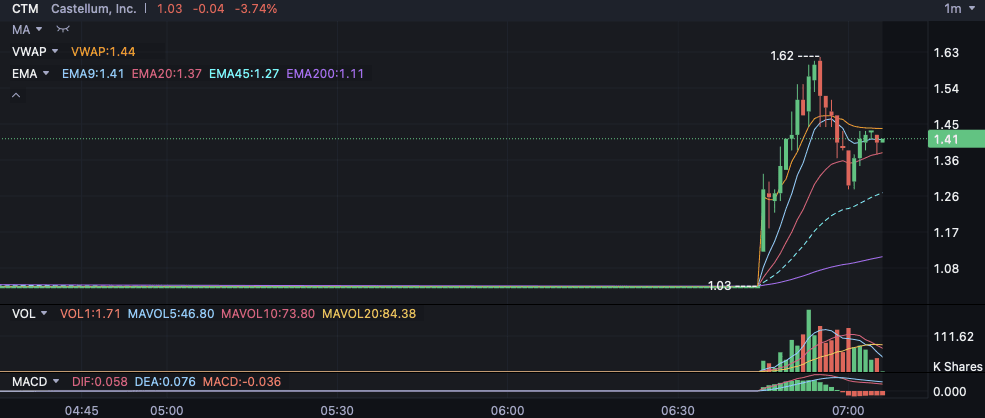
Worth being honest about what the grade is not. It does not predict whether the trade wins. It counts how many technical factors are aligned in your favor right now, which historically correlates with higher-probability setups but guarantees nothing. Treat it as a second opinion that does not know you just lost money and is not excited about the move. If you want the longer version of that argument, the post on getting a neutral second opinion on a trade setup covers it. You can also try it directly on the AI chart analysis tool.
Run Both: Grade Before, Annotate After
The point of all this is not to pick a side. It is to close the loop. Grade the setup before you enter, then annotate the outcome after it closes. Now a single trade has both halves recorded: the prediction made when it was still optional, and the result made when it was final. That pairing is the thing a post-trade-only journal can never produce, and it is what makes a review actually useful.
Here is the practical version. Before entry: screenshot, grade, save. Commit ahead of time to only taking B+ and above, so the grade is a gate, not a suggestion. After exit: add the result to that same graded entry, plus one line on whether you followed the plan. That is it. Two touches per trade, one at each end. The friction is low enough that it survives a busy open, which is the entire reason most journals die, a problem covered in the guide on keeping a trading journal you will actually stick with.
One caveat that matters. The combined loop only works if you let the grade say no. Override it three times in a session and the pre-trade half is decorative, and you are back to a rear-view-only journal that logs mistakes after they are unfixable. The discipline to skip a C-grade setup is the same discipline the journal keeps proving you need. We broke down the impulse-entry loop in detail in the post on revenge trading and overtrading.
What the Combined Loop Looks Like
A short, real-feeling example. Two trades, both halves recorded.
9:38 AM. $AAPL pulls back to VWAP on the 1-minute on about 2M shares. You screenshot before you do anything. Grade comes back A-, entry near the reclaim, stop under the prior low, target at the morning high. That graded screenshot is now in your journal, timestamped, before you have a position. You take it. It works, you take partial at T1 and trail the rest. After the close you add the result and one line: "Followed the plan, exited a touch early." Prediction and result, both on file.
10:52 AM. A small-cap is ripping and you feel the pull. You screenshot it instead of buying. Grade: C+. The volume is fading and price is below VWAP. You skip. There is no trade to journal after the fact, but the C+ is already saved, so the skip is recorded too. Three weeks later, reviewing, you can see a dozen C-grade setups you skipped and check how many would have lost. That review is only possible because the grade existed before the outcome. A purely reactive journal has no row for the trade you correctly did not take.
Notice what changed. The journal still does its long-term job, surfacing patterns across the sample. The grade does the one thing the journal structurally cannot: it shows up before the click, when the decision is still yours to make. None of this removes the underlying risk of active trading, which FINRA is blunt about, so treat the loop as a way to make better decisions, not a guarantee. Whether AI grading actually moves your numbers over a real sample is a fair question, and one we took on directly in the piece on whether AI day trading is profitable.
If you are still nailing down the underlying setups before you worry about the journal layer at all, the how to grade trades before entering guide is the better starting point. Build the read first, then bolt the loop on top of it.
Frequently Asked Questions
Is a trading journal worth it?
Yes, but only as half the loop. A journal is the best tool there is for spotting patterns across many trades: which setups you actually win, what time of day you tilt, which mistakes repeat. What it cannot do is change the trade in front of you, because by the time you write the entry down, the money is already at risk. Keep the journal for the long-term review. Add a pre-trade grade for the part the journal can't reach, the moment before you click buy.
What is the difference between a trading journal and pre-trade grading?
A trading journal is reactive. You log entry, exit, size, and notes after the trade closes, then review it later. Pre-trade grading is predictive. You score the setup before you enter, while you can still walk away. The journal tells you what your last 50 trades say about you. The grade tells you whether the one in front of you is worth taking. Reactive data teaches; predictive data prevents. Most traders only run the reactive half.
Can AI grade a setup before I enter the trade?
Yes. You upload the chart screenshot and the model scores it on pattern quality, volume, VWAP and moving-average alignment, and risk-reward, then returns a letter grade plus entry, stop, and targets. It takes a few seconds, which is the point. The grade lands before you commit capital, not after. That makes it the front half of the journal loop that a post-trade log structurally cannot cover.
Should I stop keeping a trading journal if I grade setups?
No. They do different jobs. Grading happens at entry and changes one decision. Journaling happens after and changes your strategy over a sample of trades. The strongest workflow runs both: grade the setup before you size in, then annotate the outcome after so your review has both the prediction and the result side by side. Drop either half and you lose information you can't recover later.
How do I journal a trade before I enter it?
Capture the chart the moment you would normally click buy, grade it, and that graded screenshot is your pre-trade entry. It records the setup exactly as it looked at the decision point, with a score attached, before the outcome can color your memory. After the trade closes you add the result. Now your journal holds the prediction and the result for the same setup, which is the only way to ever check whether your read was right.
Disclaimer: This article is for educational and informational purposes only. It does not constitute financial advice. Day trading involves substantial risk of loss and is not suitable for every investor. The example trades are illustrative, not a record of actual trades. AI grading evaluates chart structure and is not a guarantee of trade outcomes. Always do your own research and never trade with money you cannot afford to lose.
Related Posts
Writes about AI-assisted day trading, technical analysis, and the systems traders actually use to stay disciplined.
Write the Front Half of Your Journal
Grade the next setup before you size in. The graded screenshot becomes the pre-trade entry your journal was always missing. Your first analysis is free.