How to Keep a Trading Journal You'll Actually Stick With
Most traders quit their journal by week two. The problem is not discipline, it is friction. Here is how to build a logging habit that survives a losing week and a busy open.
Everyone tells you to keep a trading journal. Almost nobody does it past week two. The usual diagnosis is that you lack discipline, which is both unhelpful and wrong. The real reason is boring and fixable: the journal is a separate chore you do when you are most tired, and one skipped day breaks the chain. This post is about removing the friction so the journal survives a busy open and a losing week, instead of dying quietly in a spreadsheet tab you stop opening.
Quick Answer
Most trading journals die by week two, and the cause is friction rather than discipline. A journal that survives is small enough to finish in under two minutes: a screenshot of the chart, the setup grade, the reason you took it, and one line on what you would repeat. Skip the elaborate spreadsheet. Log at a fixed moment, usually right after the close, and accept a partial entry over a skipped day, because the streak is what makes patterns visible.
It's Friction, Not Laziness
The story you tell yourself when the journal dies is that you are not disciplined enough. It is a comfortable story because it locates the problem in your character, which feels true and demands nothing of you except a vague promise to try harder next week. Next week the same thing happens.
Habits do not actually run on willpower. They run on friction. The behaviors you keep are the ones that are easy and cued by something you already do; the behaviors you drop are the ones that require a separate decision and a separate chunk of effort. Research on habit formation keeps landing on the same lever: make the good behavior easier and the cue automatic. The widely cited research on how long habits take to form found it averages around 66 days, and the habits that stuck were the low-effort, clearly-cued ones. A 14-field spreadsheet you fill in after the close is neither.
So stop blaming the trader and start auditing the journal. If the journal requires you to be disciplined to maintain it, the journal is badly designed. A good one maintains itself off a step you were already going to take.
The Blank Spreadsheet Problem
Picture the standard trading journal. The textbook version is a spreadsheet with columns for ticker, entry, exit, size, stop, target, R-multiple, setup type, emotion before, emotion after, a screenshot link, and a notes field. It looks thorough. It is also a small data-entry job you have to do, by hand, at the end of a session that already drained you. Every column is a tiny decision, and you have to make all of them while tired and possibly down money.
So one day you skip it. Just today, you tell yourself, you will backfill tomorrow. You do not. Now there is a gap, and the gap is the problem. A streak is easy to continue and hard to restart, because continuing is one more of the same and restarting means confronting the gap you left. Most journals do not die from a dramatic quit. They die from one skipped Tuesday that becomes a skipped week.
The columns are also doing less than they look like they are doing. Half of them are noise you will never review, which we get into in the companion piece on what is actually worth tracking in a trading journal. The point for now is simpler: every field you add is friction, and friction is what eventually kills the whole thing. Switching apps does not fix this. The problem is when the capture happens, not where it lives.
Audit Your Journal's Friction
Before you fix the journal, see where the friction actually lives. Walk through your current process honestly and rate each step. Most of the failure is concentrated in two or three places, and they are almost always the same ones.
| Step | High-friction version | Low-friction version |
|---|---|---|
| When you log | After the close, as a separate task | At the moment of the trade decision |
| What you capture | 14 fields typed by hand | One screenshot of the chart |
| Where it lives | A spreadsheet you have to remember to open | Auto-saved the moment you grade |
| Energy required | High, and you are tired by then | Near zero, it is one action |
| Streak visibility | None, you can't see the gaps | A calendar that shows every missed day |
| Effect of a bad day | You skip it, then skip the next | Entry still saved, nothing to skip |
Every row on the right shares one property: the journal entry is a byproduct of something you were already doing, not a separate task. That is the whole design principle. If you want to see what the low-friction column looks like in practice, the next 30 seconds answers it.
Stop Maintaining a Spreadsheet
Grade a setup before you trade and the screenshot is saved as the entry, no extra step. The capture happens while you focus on the chart, not after the close. Your first analysis is free.
Grade Your First Setup FreeMove 1: Capture at the Moment of the Grade
The single biggest fix is moving the capture from after the close to the moment of the trade decision. You already look at the chart before you enter. If the journal entry is created right there, it costs nothing extra, because the action that creates it is the same action you take to evaluate the setup.
Grading the setup before entry doubles as journaling. You screenshot the chart, grade it, and that graded screenshot is the entry. It captures the setup exactly as it looked at the decision point, with a score attached, before the outcome exists to distort your memory. No after-hours typing, no blank page. The capture is a side effect of a step you were taking anyway. The full mechanics of grading a chart this way are in the walkthrough on using AI to grade trading setups, and the deeper case for journaling at entry rather than after is laid out in trading journal vs pre-trade grading.
The honest test: if your journal entry requires a second sitting after the trading day, it will eventually get skipped. If it happens inside the decision you were already making, it survives. Design for the second one.
The screenshot also beats a typed note on accuracy. A note written from memory after the close is reconstructed, and you reconstruct it to fit the outcome you now know. The screenshot is the setup as it actually was, captured before you knew whether it worked. Less effort and more honest. That is a rare combination in journaling.
Move 2: Make the Streak Visible
A habit you cannot see is a habit you will let slide. The reason streak apps work is not gamification gimmickry, it is that a visible chain makes the cost of breaking it concrete. You do not want to be the person who skipped Wednesday when Monday and Tuesday are filled in. The gap stares at you.
When the capture happens automatically at the grade, the calendar fills itself. Every graded setup drops onto its day, so the journal and the streak are the same artifact. You are not maintaining a separate tracker; the act of grading produces the record, and the record produces the visible chain.
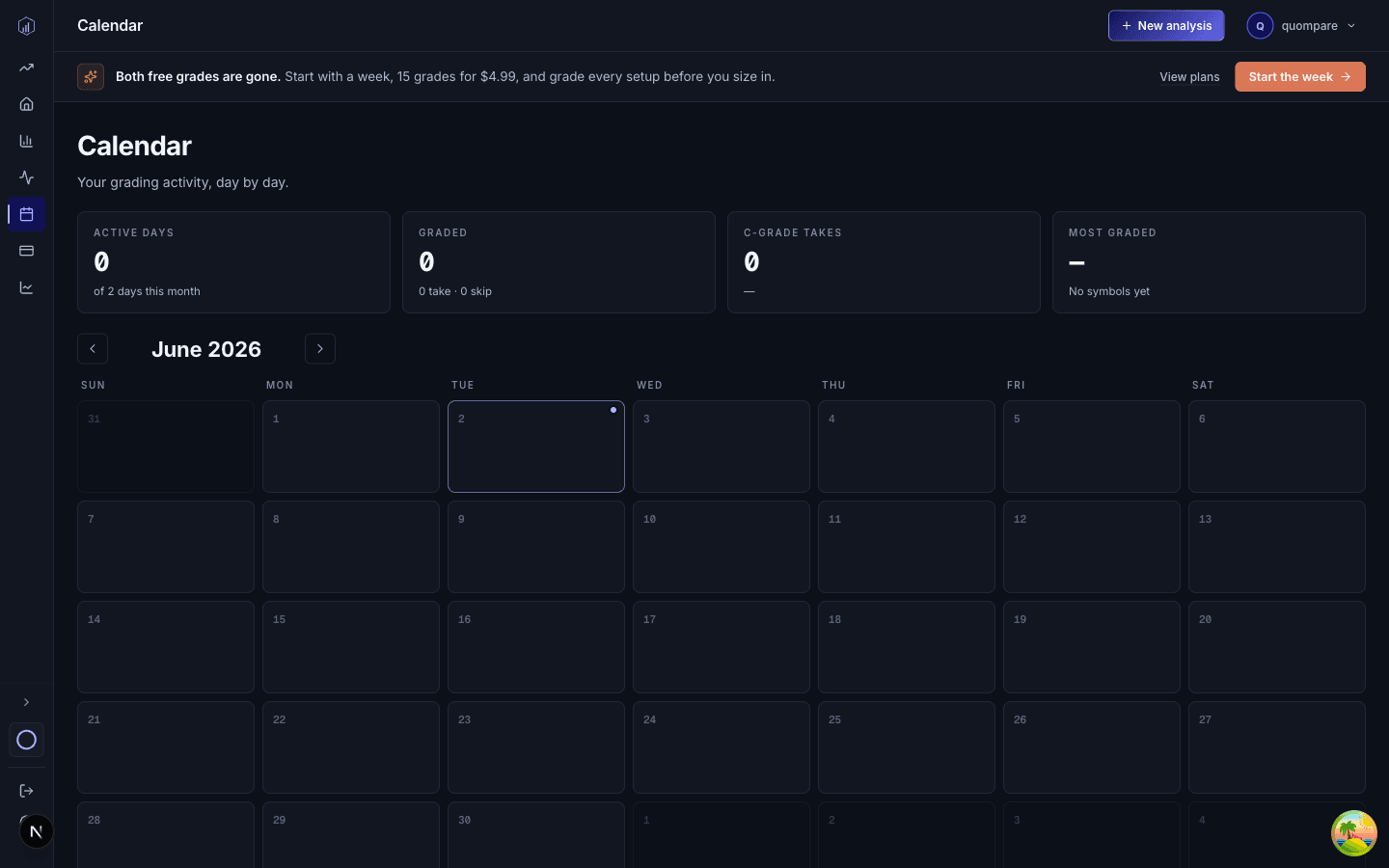
The visible gaps do something subtle. They turn a vague intention ("I should journal more") into a specific, slightly uncomfortable fact ("I have not graded a setup since Thursday"). Specific and uncomfortable is what actually changes behavior. Vague and aspirational is what every dead journal was built on.
A Journal That Survives a Losing Week
The hardest week to journal is the red one. After three losing days, the last thing you want is to sit down and stare at the record of those losses. So you skip it, exactly when the record would be most useful. This is the failure mode that ends more journals than busy mornings do.
The fix is to make the journal about the decision, not the dollars. If your entry is the graded setup at the moment you would click buy, then a losing week still produces clean, useful entries, because you logged the read, not the result. Reviewing the bad week becomes bearable, even valuable: you can separate the losses that followed the plan (good trades that happened to lose) from the impulse entries you should have skipped. One is variance, the other is a fixable mistake, and only the journal can tell them apart. That distinction is the whole point of the post on how to avoid bad trades.
Keep the streak, lower the stakes
On a red day, the bar to clear is one graded setup, not a full P&L reconciliation. Grade one chart, the day is logged, the chain holds. You can do the painful review later, when you are not raw.
Let the calendar carry the week
A losing week with every day still graded looks like a process holding together under pressure. That is a much better story to tell yourself than a blank week, and it is true.
A journal that only gets filled in on green days is a highlight reel, and a highlight reel teaches you nothing. The losing weeks are where the lessons are. Build the journal so it survives them, and it becomes the most useful thing you own.
The Routine, Start to Finish
Putting the three moves together, here is a routine that survives both a busy open and a draining week. It is deliberately short, because a routine you can describe in four lines is a routine you will actually run.
Before each trade
Screenshot the chart and grade it. That graded image is your entry, saved when you grade. Commit ahead of time to only taking B+ and above, so the grade is a gate, not a note.
End of day, 60 seconds
Glance at the calendar. Did today fill in? Add the outcome to your graded setups and one line on whether you followed the plan. That is the entire daily touch.
End of week, 10 minutes
Open the week. Which grades won, which lost, how many C-grade setups did you skip versus take. This is the review the daily capture made possible, and it is where the journal pays you back.
What you deleted
No emotion sliders, no 14-column spreadsheet, no after-hours data entry. You removed the friction that kills journals and kept only the steps that change how you trade.
The deeper reason this works ties back to discipline. A journal you keep is a form of pre-commitment, and pre-commitment is the whole game, as the post on building trading discipline as a system argues at length. You are not relying on being a better person tomorrow. You are removing the steps that made yesterday's journal die.
If you want to see the capture-at-the-grade idea in practice, you can grade your next setup on the AI chart analysis tool and the entry lands in your journal on its own. One avoided C-grade setup usually pays for the week, and now you have the record to prove which ones you skipped.
Frequently Asked Questions
Why do most traders stop keeping a trading journal?
Friction, not laziness. A blank spreadsheet with a dozen columns is a separate chore you do after a draining session, and it is the first thing to get skipped when you are tired. Skip one day and the streak breaks, and a broken streak is psychologically much easier to abandon than to restart. The fix is not more willpower. It is removing the friction so the entry takes one action at the moment you are already looking at the chart.
How do I make a trading journal a habit?
Attach the entry to something you already do. You already look at the chart before you trade, so make the capture happen there, not as an after-hours task. Keep the entry tiny, one screenshot instead of fourteen fields, so it survives a bad day. Then make the gaps visible with a streak or calendar view, because a visible missed day is a far stronger nudge than a vague intention to be more consistent.
Is a screenshot enough for a trading journal?
For the capture step, yes. A timestamped screenshot of the chart at the moment of decision holds more honest information than a paragraph you write from memory after the close. It records the exact setup, the indicators, the price, before the outcome can color how you remember it. You can add a one-line note and the result later. The screenshot is the entry; the typing is optional polish.
How do I keep journaling through a losing week?
Make the journal record the decision, not the dollars. If the entry is the graded setup at the moment you would click buy, a losing week still produces clean entries, because you are logging the read, not the result. Reviewing a losing week then becomes useful instead of painful: you can see which losses followed the plan and which were impulse trades you should have skipped. The week stops feeling like a reason to quit and starts feeling like data.
Does an automated trading journal actually work better?
It works better at the one thing that kills journals, which is consistency. If the entry is created automatically the moment you grade a setup, there is no separate chore to skip and no blank page to dread. Capture stops depending on your end-of-day energy. You still do the review by hand, because the thinking is the point, but the recording happens on its own, and recording is the step most traders drop first.
Disclaimer: This article is for educational and informational purposes only. It does not constitute financial advice. Day trading involves substantial risk of loss and is not suitable for every investor. A trading journal is a tool for review and does not guarantee improved results. Always do your own research and never trade with money you cannot afford to lose.
Related Posts
Writes about AI-assisted day trading, technical analysis, and the systems traders actually use to stay disciplined.
A Journal Without the After-Hours Chore
Grade a setup and the graded screenshot is already saved as the entry. No blank page, no after-hours chore, no broken streak. Your first analysis is free.